|
| Islamic State on its way to Palmyra. |
The Independent on Sunday
published this article of mine some years ago, so long ago in fact that
I had not yet given up smoking, nor had the hotel bar at Palmyra
dreamed that the day would come when Islamic State would save them from
having to figure out how to make a decent Alabama Slammer.
Some
of us cannot go to Palmyra anymore, but others of us can, and with the
news that Islamic State has now entered Palmyra this seems a good time
to republish an article about the ancient site which provides the sort
of helpful cultural and historical insight any tourist needs before
smashing the place to bits.
* * *
At the bar of the new five-star hotel, I
ordered an Alabama Slammer and would have settled for an arak and a glass of
orange juice, but it made no difference; I was treated to total and lengthy
incompetence. 'He's new,' the head barman explained, 'a local bedouin boy who
knows nothing. You can visit their tents around here. Of course they are not
really nomads anymore. They earn a living from tourism to Palmyra.'
 |
| Palmyra in the Syrian Desert. |
Late the next day, after I had been walking
around the ruined city in Syria, whose biblical name is Tadmor, an old bedouin
invited me into his tent, pitched against the wall of a tower tomb to benefit
from its afternoon shade. We lounged Roman-style against woven bolsters and
were served glasses of tea by an animated young woman. She was his third wife,
he told me, gesturing his virility with his fist. The previous two had died but
had given him sons; one was a schoolteacher, the other worked in the new
five-star hotel.
Outside, a few sheep made a pretence of
grazing over the burning sands. But the old man inside, helped out now by a son
teaching children how to read and write, and by another learning how to serve
an Alabama Slammer, could afford to retire from the nomad business. The young
woman reached without reticence for one of my cigarettes, and I saw that her
hands were tattooed, that her wrists flashed with gold - and that the floor of
their tent was made of concrete.
 |
Bedouin tents take on
a sense of permanency. |
Baedeker's 1912 guide to Palestine and
Syria tells that the journey from Damascus to Palmyra took four days by camel,
five days on horseback or by carriage. Water was a problem and an armed escort
was desirable. A supply of tobacco was recommended to keep the local bedouin
sweet. Happily for lunatics, there was the convenience of a famous cure en
route - a village where the sufferer was shackled overnight within a room; in
the morning his chains would fall from him and miraculously the affliction
would vanish.
The need for treatment is reduced these
days, as the drive from Damascus is less than three hours. Even so, when the
sun is high and the desert is blanched of colour, there is time enough for the
tedious horizons to fill with spectral things. Pairs and sometimes entire
families of twisters spout suddenly like fountains from the ground, dust clouds
sweep across the road and phantom pools of water levitate deliciously above the
sands. In the distance, black bedouin tents seem like the carapaces of dead
beetles consumed by heat.
Even 4000 years ago, travellers arrived at
the oasis of Palmyra to find refuge against this delirium of sand and sun. To
the west lay Anatolia and the Mediterranean, to the east Mesopotamia and India,
but between east and west lay the terrors of the Syrian Desert. Offering
sustenance and water to caravans navigating this perilous wasteland, Palmyra
stood at the central joint of the ancient world - and prospered.
 |
Funerary bust of a wealthy
Palmyrene woman. |
Though there had been a settlement here for
thousands of years, it was with the prosperity brought by the spread of the
Roman empire 2000 years ago that, around a stinking spring amid a sea of sand,
the Palmyrenes raised their gleaming metropolis of stone. It is the wreck of
this improbable city that brings you to the middle of nowhere. Some Palmyrenes
no doubt continued to wait at table and serve drinks at the bar, so to speak,
but others dived into commerce and finance, their strings of camels following
the Silk Route, their ships on the lower Euphrates meeting the traffic of
spices, ivory, ebony and pearls from India and the Gulf.
In the Palmyra Museum you see statues of
these middlemen of antiquity lounging at their banquet tables, their women
drowned in jewels, setting off their ostentation with a sourness in the
downturned corners of their mouths. A relief at the Temple of Bel shows that
gods as well as goods travelled about on the backs of camels. Palmyra was a
trading city through and through, its great colonnaded avenue lined with shops,
the columns bearing consoles on which once stood not statues of mythic heroes
or generals, but of businessmen who had literally earned the honour.
 |
A Palmyrnee merchant,
wealthy and content. |
But the Palmyrenes do not look like a
people who would go out in the midday sun. Neither energy nor adventure nor
spirit nor even beauty disturbs the almost flabby complacency of their gaze.
Only on their tombstones is there a hint of feeling, when sometimes they were
so far moved as to inscribe: 'Alas'.
You are led to the spring today by the
sound of laughter. From a fissure in the rock it pumps its hot sulphurous
waters into a sunken pool by the roadside. Peering down, you see local boys
splashing one another. This was the source of empire.
Its steaming waters are led through
channels round an oasis of date palms, half a million it is said, though
pomegranates grow here too, and figs, and olives. At night when the westerly
breeze blows through the leaves, it is like the sound of waves lapping against
a distant shore. By day it is wonderful to wander here among the shadows and
fragrances and the swoops of brilliantly feathered birds. Children surge along
the dappled lanes, their laughter bubbling like the channelled water.
 |
| Palmyra rises in an oasis fed by a small sulphurous spring. |
The bones of the ancient city, however, stand
out on the pitiless sands. In the midst of the ruins is the old Zenobia Hotel -
its ceilings built for giants, its mattresses for breaking backs. But it has a
terrace, its tables made up of Corinthian capitals fallen from the avenue of
columns marching past you in the thin lemony light of early morning. This is
the place to sit and hold a warming glass of thick sweet tea in your hands as
the sun rises behind you, its rays touching the ancient stones with fire.
The hotel is named for the third-century Queen
of the East, who for a brief impetuous moment touched Palmyra with romance and
then brought it to destruction. To the Roman peace, most of all, Palmyra owed
its fortune. To the limits of the Euphrates, the highways of trade knew
unprecedented security - and after the Emperor Trajan broke the power of Petra
early in the second century AD, the Romans ensured that the wealth of the
Orient passed through Palmyra. The once splendid city whose ruins now lie
before you belongs almost entirely to those first three centuries AD.
At the edge of the grove but rising higher
than the palms themselves, the great Corinthian columns of the Temple of Bel,
the most high god of Palmyra, dominate the city. Once the columns carried
capitals of bronze which must have shone like flares in the sunlight. Reliefs
show offerings of fruit; one painted panel of exquisitely carved vines bears
succulent, coloured grapes. From atop the temple walls you can look out over
the oasis and eastwards across the limitless sands, and you can also survey the
whole of Palmyra - nearly half the size of Alexandria, then the largest city in
the world apart from Rome.
Beyond a monumental arch the colonnaded
avenue strides off through the heart of the city; past the remains of shops and
baths and a well-preserved theatre; until it reaches the main crossroads marked
by the tetrapylon - four pedestals supporting four massive columns each, the
sets of columns topped with an entablature. The tetrapylon has been
reconstructed and only one of the columns is entirely original, a pink granite
monolith brought from Upper Egypt, which - multiplied by 16 - means a transport
task of pharaonic proportions.
 |
| Queen Zenobia captured by the Romans. |
Still farther is the camp of Diocletian;
beneath it, irony more than evidence places the remains of Zenobia's palace.
The camp was built within 30 years of Zenobia's downfall, when Palmyra was
hardly more than the short straw for the lonely legions standing picket at the
dead end of the Roman Empire.
Zenobia had presumed to challenge the might
of Rome in AD 270, leading her armies to the Nile and into Anatolia. 'She claimed
her descent from the Macedonian kings of Egypt,' wrote Gibbon, 'equalled in
beauty her ancestor Cleopatra, and far surpassed that princess in chastity and
valour. Zenobia was esteemed the most lovely as well as the most heroic of her
sex.'
Zenobia was in fact of Arab stock, her
family originally merchants who, before that, had perhaps been desert nomads.
But her husband had been king, and he had served the Romans well, patrolling
their eastern provinces as far as the Euphrates. For his loyalty at that
disastrous moment when the Emperor Valerian was beaten and captured by the
Persians, the Palmyran was named 'Corrector of the East' and Imperator. Then
mysteriously he was assassinated, and taking advantage of Roman troubles with
the Germanic tribes, Zenobia declared herself Augusta, laying claim to the
whole Roman Empire.
Control of the trade from India to Europe
via the Euphrates, the Red Sea, the Nile and the Bosphorus was her aim. But in AD
272 the Emperor Aurelian marched against her, captured Palmyra and brought
Zenobia back to Rome in triumph, leading her through his city in chains of gold.
When the Senate mocked him for his victory over a woman, Aurelian is said to
have replied: 'Ah, if they only knew what a woman I have been fighting] And
what would history say if I had been defeated?'
Zenobia is said to have ended her days in a
villa at Tivoli. Palmyra was left to exhaust itself alone, once more rising
against the Romans, forcing Aurelian to return. This time he sacked the city.
It never recovered and the sands washed in. They have here and there sucked
away at the stone, grotesquely reworking the columns to create the effect of
elephantiasis.
 |
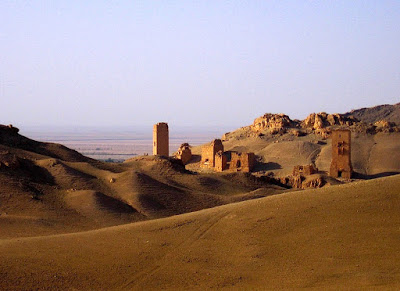
| The most
ancient things in Palmyra are its tower tombs; inside they are arranged
in ascending rows of what look like left-luggage lockers, each filled
with a body. |
At evening the sun drains from the sky but
the stone of Palmyra's ruined temples, arches and colonnades still seems to
glow with the stored radiance of the day. It is then that your eyes are drawn
to the most special thing about Palmyra, eerie and entirely alien - its tower
tombs pulsing against the blackening west. Built from the first century BC,
before Palmyra dressed itself in Roman forms and before its matronly and
imperial pretensions, these are its most ancient funerary monuments.
Standing apart from the city, these
sepulchral towers rise several storeys tall into the night. Inside they are
arranged like left-luggage lockers, each body stacked atop the compartment of
another. It is like having a tent with a concrete floor; their occupants have
come to rest, but they still like to feel in transit.