Tuesday, 28 January 2014

'Open cities are the mothers of open societies': John Fowles, Lawrence Durrell, E M Forster and Alexandria


Open cities are the mothers of open societies, and their existence is especially essential to literature - which is why, I suppose, we cherish our illusions about them, and forgive them so many of their sins. In the case of Alexandria, that prototype cosmopolis and melter of antitheses, we can hardly be blamed. Antony and Cleopatra, Cavafy, E M Forster, Lawrence Durrell ... there is a formidably distinguished list of foreign celebrants and from them we have taken an indelible image of the place. It is languorous, subtle, perverse, eternally fin de siècle; failure haunts it, yet a failure of such richness that it is a kind of victory.

          - John Fowles, introduction to
              Naguib Mahfouz' Miramar

The Tauris Parke Paperback 2014
reprint of Forster's Alexandria.
Two events have set me to recollecting the British publishing history of E M Forster's Alexandria: A History and a Guide and how it came to include an introduction by Lawrence Durrell.  One event is the publication today, 28 January 2014, of the Tauris Parke Paperbacks reprint of Forster's book. The other is a copy of my own Michael Haag Ltd edition of Forster's Alexandria which once belonged to John Fowles that I came upon in a rare and antiquarian bookshop.  

John Fowles' copy of the 1982
Michael Haag Ltd edition.
The cover is by my friend Colin Elgie.
I published the first British edition of Forster's Alexandria in 1982. I had approached John Fowles to write the introduction; Lawrence Durrell was the more natural choice, particularly because he had quoted from Forster's History and Guide in his Alexandria Quartet, but I was having difficulties with Durrell.

Durrell imagined that he had already written an introduction to Forster's Alexandria but could find no trace of it, so he wrote to The Times Literary Supplement where his letter appeared on 22 August 1980.  Not only had he written it, he said, but 'I saw and handled a copy with my preface. The little note even earned the approval of Forster, for he gave me a kindly passing mention as a "late lover of the city"'.

Durrell's letter to the TLS.
In fact I was pretty cross with Durrell and told him if he did not want to write the introduction he should just say so, and not give me a cock and bull story.  And so his letter to the TLS continues that the disappearance of his preface was so complete that the publisher, that is myself, who was asking him to write the introduction, was 'coming to believe that I am romancing' - which was putting it mildly.

Not only cross, but I had given up on Durrell and had written to John Fowles, author of The Magus and The French Lieutenant's Woman.  He had written a wonderful introduction to The American University in Cairo Press' translation of Naguib Mahfouz' Miramar, his novel set in Alexandria.  

Mahfouz was directly influenced by Durrell when writing Miramar and opens with lines that could have been written by Durrell himself: 'Alexandria. At last. Alexandria, Lady of the Dew.  Bloom of white nimbus. Bosom of radiance, wet with sky-water. Core of nostalgia steeped in honey and tears'.

The original AUC Press edition of Miramar.
Fowles' introduction to Miramar begins with the lines I have quoted at the top of this post, and then he adds, 'What we have conspicuously lacked ... is a view from the inside, from modern Egypt herself', and he welcomes Mahfouz' Miramar for providing it - and for continuing the tradition of writing about a city that when Mahfouz published his novel in Arabic in 1967 still had some afterglow, some memory, of having been an open city, those mothers of open societies.

But then I heard from John Fowles who admitted that despite his introduction to Miramar and having visited Cairo he had never been to Alexandria. He suggested I try Edmund Keeley or Philip Sherrard, the translators of Cavafy, or that I approach John Rodenbeck, who had been Fowles' host in Cairo.  Rodenbeck was professor of comparative literature at The American University there and the director of The AUC Press; he had excellent contacts and knew a fair bit about the literary dimension of Alexandria himself.

Meanwhile there was silence in the letters columns of the TLS. Then in September a rare books dealer replied to Durrell's letter, telling him that no such introduction by him existed, at which point Durrell wrote me a charming apology for 'the wild goose chase', saying 'I must have dreamed it'. And he immediately agreed to write the introduction to Forster's Alexandria.

Durrell's introduction turned out to be a beautiful piece of writing, one of the best short pieces Durrell ever wrote.  Forster and Durrell made a classic combination, and Durrell himself was immensely proud, I know, to have contributed to my edition, the first British edition, of A History and a Guide.

Durrell's original typescript of his introduction.
When my edition of Forster's book was published I sent a hardback copy to Fowles.  On the flap of the dust jacket, and on the inside cover of the paperback version, I included his wonderful description of Alexandria and its importance to literature and free thought.  What happened to his copy I do not know.  But recently, as I have said, I spotted a paperback edition bearing his signature of ownership and dated 2004; that is the one I have now bought, not that I collect books, but it seemed that this copy of Alexandria had made itself known to me in order to return home.

Fowles' signature on the frontispiece.
The inside front cover and half title page showing the quote from Fowles and his signature.
Fowles replied to my letter and the copy of the book.  'I am delighted that Durrell did in fact write the introduction in the end.  I could not have hoped to equal that.'

John Fowles' letter to me after my publication of Forster's Alexandria with Durrell's introduction.
But I wish Fowles' introduction to Mahfouz' Miramar was still in print; as far as I know it is not. His words about open cities being the mothers of open societies say everything about Alexandria, the city that was home to Cavafy, Forster and Durrell, its afterglow, its memory, all but gone now. 

Tuesday, 21 January 2014

Mummified Crocodiles

Mummified crocodiles.
I have recently acquired a new desktop computer.  I needed to install Microsoft Office in order to use Word, the software almost universally used for writing documents and which I have long used for writing books.  But unlike every other computer I have ever owned, it turns out that this one does not have a slot for CDs or DVDs.  So how am I to install Word?  And for that matter how do I back up files on CDs or photographs or anything else?  

Yes, I know about saving things in the clouds but that has seemed an airy-fairy thing to me.  Can you really believe that you have saved anything by surrendering it to some cloud thousands of miles away?  Not me; and so I have used CDs and DVDs as my last line of memory.

But now I have no choice.  My computer will not accept CDs or DVDs.  I had to install Microsoft Office by downloading it from a cloud.  And if the thing goes wrong I can go back to the cloud and download it again.  The plain fact, I realise, is that discs are on the verge of obsolescence; soon they will be no more.  This remote and hardly believable cloud is the present and the future.  All my memories, and all yours, will hover about somewhere in a cloud.  

I have been through this before, this serial obsolescence.  First there were big floppy discs; then they were replaced by smaller floppy discs; and they in turn were replaced by CDs and DVDs - which you would think would last forever, but they degrade surprisingly quickly ('disc rot' or 'laser rot', to give it the high tech term), within twenty years, even within a few months.  

Even if the memory storage object, the CD or DVD or floppy disc, did not degrade, the devices for operating them are not made anymore.  Try to find a machine that will operate a floppy disc.  Or a video machine that will operate a tape cassette.  It is easier to find an old record player, even a wind-up record player, to play your music collection of non-degradable vinyl records - the ones you threw out twenty years or so ago to keep up with the times and which always delivered higher sound quality than any disc. 

I will not go on about the virtues of yet earlier devices I have used for writing, such as the typewriter, or paper, pen and ink.  

But I have been thinking about mummified crocodiles.

Mummified crocodiles dug up at Tebtynis.

With the exception of our own times, there has been no period or place better documented and understood, right down to the smallest details of everyday life, than Graeco-Roman Egypt, that is Egypt from about 330 BC and for a thousand years onwards, when it was ruled by the Ptolemaic dynasty which ended with the famous Cleopatra at whose death it became a Roman and Byzantine province until the Arab invasion in 642.

The reason for this is to be found in the crocodile cemeteries of Tebtynis (also called Tebtunis) in the Fayyum oasis.
  
Digging for crocodiles at Tebtynis.

Searching for mummified crocodiles wrapped in papyrus.

How this came to be is described by the British Egyptologist and classicist Bernard Grenfell, writing in Fayum Towns and Their Papyri, published in 1900.  In 1899 he and his colleague Arthur Hunt had gone to the Fayyum in a search for human mummies; instead they made a momentous discovery.  
The tombs of the large necropolis adjoining Tebtynis proved in many instances to contain only crocodiles. One of our workmen, disgusted at finding a row of crocodiles where he expected sarcophagi, broke one of them in pieces and disclosed the surprising fact that the creature was wrapped in sheets of papyrus. As may be imagined, after this we dug out all the crocodile-tombs in the cemetery. The most remarkable characteristic of the Greek papyri from crocodile-mummies is their great size. For enfolding crocodiles 3 or 4 m in length small documents were useless, though they were employed as padding, in which case they had often not been unrolled or were hastily crushed together. For the outer layers the papyri used consisted of large unfolded rolls.
With the old order confronted by foreign influences, Egyptians of the Late and Ptolemaic periods increasingly clung to tangible shreds of belief, so that animal cults came to enjoy an astonishing popularity. At Saqqara the priests had long been giving magnificent burials to the Apis bulls, but now new and vast underground chambers were established - the Anubieion, sacred to Anubis, with a gallery for dogs; the Bubasteion, sacred to Bastet, filled with mummified cats; the temple of Thoth, its subterranean galleries piled high with thousands of baboons and millions of mummified ibises and falcons; and the Isieion, the temple of Isis, with underground galleries containing the sarcophagi of the sacred cows that had given birth to the Apis bulls. 

Most votive crocodiles were infants; adults have greater data storage capacity.
These uncountable numbers of mummified creatures were brought over hundreds of years by pilgrims as offerings to a favoured god, or as supplication by those seeking a cure. For the Egyptians animals carried within them the quality of the eternal, just as over the years it always seems to be the same bird that one hears singing in the branches of a tree, so that animal cults were a reassurance that Egypt was at one with the sacred and things would remain fundamentally unchanged. 

The intensity of Egyptians' feelings in the matter can be gauged from the incident witnessed in the first century BC by the Greek historian Diodorus Siculus in Alexandria, when a Roman diplomat accidentally killed a cat and was immediately lynched by the mob.

In other words mummified animals were a way of commemorating the past, remembering traditions, preserving culture and connecting with the sacred. 

Bernard Grenfell and Arthur Hunt.

But not only ethnic Egyptians indulged in animal worship and mummification.  Greeks and Romans who settled in Egypt and whose families lived there for centuries adopted Egyptian practices.  This was especially true in the Fayyum oasis where the crocodile god Sobek was worshipped and offerings of crocodiles made at his temples, in the capital called Crocodilopolis and elsewhere round the oasis, as at Tebtynis.  In Graeco-Roman Egypt Sobek was honoured as a protective deity, fierce in warding off evil while at the same time healing the sick and defending the innocent.  
A treatise on the medical properties
of plants.
Grenfell and Hunt's great discovery was not the crocodiles themselves but their papyrus wrappings which amounted to over thirty thousand fragments concerning everything from agricultural and irrigation management, leases, contracts, tax receipts, reports of burglaries and missing persons, to scientific, mathematical and medical treatises, and also literary works by Pindar, Xenophon, Sophocles, Euripides, as well as parts of Homer's Iliad and Odyssey.

A fragment of the Iliad,
Book XI, 11, 556-613.
Discarded pieces of papyrus, used to bulk up crocodile mummies or enwrap them, have given us a detailed understanding of the administrative, social and economic history of Egypt and the ancient Mediterranean world, as well as an intimate look into people's lives.  


A second century BC portion of Sophocles' lost play Inachus.
In these days when people no longer put pen to paper or even use a typewriter, when CDs and DVDs rot within twenty years, one wonders what will be left of us for future generations.  For all our tweets and text messages we are creating a world without a memory, a place without a trace, a time that will be immediately forgotten.  Unless you really believe that something will remain out there on a cloud - mostly collected and one hopes preserved by America's National Security Agency, Britain's GCHQ, and the French, German, Russian, Chinese, Israeli and Iranian intelligence services. 

Declaration of a birth AD 50.
But if you really want to be sure of saving what you write, a far superior memory device is a crocodile mummy with a proven life of over two thousand years. 


[For an update on the necessity of crocodiles click here.]

Monday, 23 December 2013

Christmas in Provence

A Provençal nativity with local villagers dropping in.
In Monsieur: The Prince of Darkness, the first book of his Avignon Quintet, Lawrence Durrell writes lovingly about Christmas in Provence. 'In my memory it will always be Christmas here', says Durrell's character Bruce, 'the Noel of 19-, the year that changed the direction and leaning of my life. Nothing had ever happened to me before - or that is how I felt about the events of that year.'

Bruce is visiting the chateau of Verfeuille in Provence where he and Sylvie fall in love.  The chateau is owned by Bruce's friend, Piers, who is Sylvie's brother, and you might as well know that Piers and Sylvie are also in love with one another. That is not so unusual in Durrell's novels; Pursewarden and his sister Liza in The Alexandria Quartet are lovers, for example, and there are many other relationships in the Quartet and elsewhere that are disguised brother-sister affairs - just as sometimes in E M Forster's novels, notably in Howards End, the relationships are disguised homosexual ones. 

Piers had gone ahead to Verfeuille, 
while Sylvie and I had elected to stay on in Avignon, and then pick up horses at the half-way house and ride the last few miles to the chateau. Our saddle bags were full of presents, coloured sweets for the children, confetti, crystallised fruit, and little bottles of cognac and liqueurs. Also we had brought a huge family of little santons of painted terracotta for the crèche. No Provençal Christmas is complete without these little figures which populate and deck out the family crèche which itself does the duty of our northern Yule-tide Tree. 
Santons pay their respects to the newborn child.
I became curious about these santons - the word means 'little saints'.  Curious about their place in the Christmas festivities of Provence but also because I wondered what they might signify, if anything, about Durrell's characters.  Just as in the Alexandria Quartet Durrell describes his characters in terms of tarot cards, so maybe these santons who have invaded the traditional nativity scene with the Holy Family also had some meaning.  But probably not - though Durrell can never resist a homunculus. 

Durrell goes on to explain.  
Originally the cast, so to speak, was a small one, restricted to the Holy Family and two or three other personages who figured directly in the legend, like the kings and so forth; but under the influence of the hardy Provençal sense of poetry the whole thing had flowered rhapsodically and we had found in the shops about forty santons, all different. Their verisimilitude might have been suspect but they brought the story up to date with characters out of stock like the village policeman, a poacher, a Camargue cowboy, and the like. All this gear was carefully wrapped against breakages and stowed in our capacious saddle bags before we attacked the slow winding ascent to the chateau.
In Caesar's Vast Ghost, Durrell's book about Provence, he says 'The little Christmas santons of Provence with their butcher-baker-candlestick-maker preoccupations must echo the same concern with the persistence of archetypes through the different vocations'.  

A santon produce-seller.
And so they turn out to do, and in a surprising way. For on the face of it there is nothing ancient about these santons, these figurines of painted terracotta; the tradition is barely two hundred years old. They owe their existence to the French Revolution and its suppression of religion and outward displays of belief, including the traditional nativity scene with its Joseph and Mary and Christ Child and magi and shepherds and sheep and cows and so on - all of this was banned.  But people liked them.  And there were artisans who had made a living turning them out.  And so everyone just continued on as before, but instead of the Holy Family the figures were butchers and bakers and fishwives.  And the santons thrived.  No Christmas in Provence is complete without a vast cast of characters who have nothing to do with the birth of the Son of God but everything to do with one's neighbours and local tradesmen and the passing gipsies and fishermen at sea.


As for Bruce and Sylvie making their way back from Avignon to the the chateau, their saddlebags filled with santons,
From time to time all visibility was reduced to nil, and then Sylvie, who was in a particularly mischievous mood, pushed her horse into a canter, to be swallowed at once in the mist. It was not a procedure to be recommended and the second time she did it I plunged after her and punished her with an embrace that left her breathless; feeling her cold lips and nose against my face, seeking me out. Such was its magnetism that we became fused into this posture, unwilling to detach ourselves from each other. I tried to at last - for I could feel the mist condensing into droplets on the collar of my old tweed coat; but she whispered 'Stay' and it was only too easy to obey her.
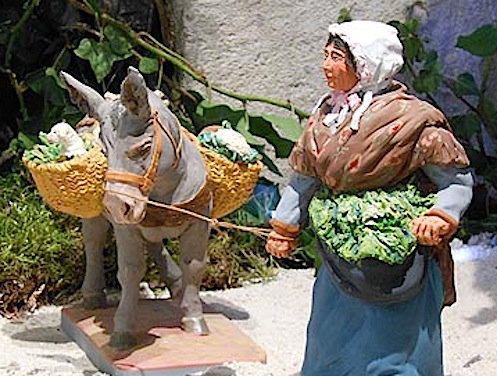
Santon woman with donkey.
Their arrival at Verfeuille was followed by a warming log fire and a magnficent Christmas dinner. (If you want to know about the traditions of a country, particularly the gastronomic ones, you could do worse than read a Durrell novel.)

The wine was going about now and the most important supper of the whole year was in full sail. By old tradition it has always been a 'lean' supper, so that in comparison with other feast days it might have seemed a trifle frugal. Nevertheless the huge dish of raïto exhaled a wonderful fragrance: this was a ragout of mixed fish presented in a sauce flavoured with wine and capers. Chicken flamed in Cognac. The long brown loaves cracked and crackled under the fingers of the feasters like the olive branches in the fireplace. ...

So it went on, our last dinner, to terminate at last with a whole anthology of sweetmeats and nuts and winter melons. The fire was restoked and the army of wine-bottles gave place to a smaller phalanx of brandies, Armagnacs and Marcs, to offset the large bowls of coffee from which rose plumes of fragrance.

Now old Jan's wife placed before the three lovers a deep silver sugar bowl full of white sugar. It lay there before them in the plenitude of its sweetness like a silver paunch. The three spoons she had placed in it stood upright, waiting for them to help themselves before the rest of the company.
For Bruce, that Christmas remained forever impressed into his mind.  
It was not a place or time easy to forget, and I had returned to it so often in my thoughts that it was no surprise to relive all this in my dreams. I must have unconsciously memorised it in great detail without being fully aware of the fact at the time. I know of no other place on earth that I can call up so clearly and accurately by simply closing my eyes: to this very day.
But the day itself came to an end as they moved off across the snow to midnight mass at the village church.
Painted terracotta figures coming to life.
By now the old man had discovered that it was nearly time for the village mass. 'We will have to hurry up,' he said consulting the old clock, 'we must set a good example on the day of the days.' The company donned hats and scarves and we straggled out into the night with its washed-out late moon trying to guide us. Our feet scratched the flinty path which led away to the tiny hamlet of Verfeuille whose ancient church was now so ablaze with candles that the whole fragile structure seemed to be on fire. I walked arm in arm with the brother and sister, silent and preoccupied and wondering about the future – the future which has now become the past.
Except that with Durrell nothing ever becomes lost within the past. Time plays itself out again and again, like the placing of familiar tarot cards and like santons introducing themselves into the world of ancient beliefs and mysteries, as the following volumes of the Avignon Quintet make clear.
Sommieres, the town where Durrell lived in Provence, with the Roman bridge crossing the Vidourle - recreated like a nativity scene and populated by santons. 

Saturday, 21 December 2013

L'ascension et la chute


The French edition of my book The Tragedy of the Templars will be published by Ixelles Editions on 5 February 2014 as La Tragédie des Templiers: L'ascension et la chute.


Under the title Les Templiers: De la légende a l'histoire, Ixelles already publish the French edition of The Templars: History and Myth.

Saturday, 7 December 2013

English Cavafy

One of the last photographs taken of Cavafy, 1932.

I was reading this entry for the Greek poet Constantine Cavafy in The Oxford Companion to English Literature.  It mentions the several ways in which Cavafy is connected to England and the English language and which justify his inclusion in this companion.  

But what it fails to mention is how much Cavafy's mind was an English mind and how his Greek poetry began life in the English language.

When reading Cavafy's poetry in English translation one has the uncanny sense that one is reading it in a language whose rhythms and nuances inhabited Cavafy.  Cavafy spent many years of his childhood and youthful education in England and to his dying day he spoke Greek with an English accent and he most certainly first 'thought' some of his poems in English before writing them in Greek.

Evidence of this was found by Gwyn Williams who in the 1930s was a lecturer in English literature at Fuad (later Cairo) University and then became a close friend of Lawrence Durrell's in Alexandria during the Second World War, by when Williams had become head of the department of English Literature at Farouk University in the city (today's Alexandria University).   

After Cavafy's death in 1933, Cavafy's friends and downstairs neighbours Rika and Alexander Singopoulos brought out the first edition of Cavafy's works, but there were also numerous pieces of paper of all sizes and quality, some of them pages torn from exercise books, others small irregular scraps, on which Cavafy had scribbled severely truncated, almost coded notes in English - some of them after he had been out prowling at the tavernas. 

Rika and Alexander Singopoulos wanted them deciphered, and so they gave a sheaf of these papers to Michael Perides, another friend of Cavafy's, for Gwyn Williams to see. Many offered glimpses into his homosexual emotional life, while others, to Williams' surprise, bore first drafts of his poems written in English prose which Cavafy would then rework into poetry in Greek. 

As The Oxford Companion to English Literature says, for more on Cavafy 'see Michael Haag, Alexandria: City of Memory (2005)'.

Alexandria in World War II

Alexandria in World War II is a 'found poem' composed by Anis Shivani and published in the summer 2013 issue of The Missing Slate.  It was 'found' in my Alexandria: City of Memory; that is all the words and phrases are taken directly from my book.  I have only just found it myself, by chance, on the internet.  It works very well, I think, and made me smile.

The Britannia Club at 26 Rue Fuad, “proof of the British ability”:
we danced with Durrell’s future friend the painter Clea Badaro
during the summer the Burg el Arab served as base for Indian troops,
the long-threatened concert party having descended in force.

We danced with Durrell’s future friend the painter Clea Badaro,
marching about in a snake dance including the band at the Excelsior,
the long-threatened concert party having descended in force.
Since spring, Geneva has thrown open her home to soldiers.

Marching about in a snake dance including the band at the Excelsior,
air raid in the middle, buffet afterwards, breakfast for sixteen.
Since spring, Geneva has thrown open her home to soldiers,
the Choremis, the Benachis, the Casullis, the Salvagos and others.

Air raid in the middle, buffet afterwards, breakfast for sixteen,
the Karam Palace became very grand, almost too grand I’m afraid.
The Choremis, the Benachis, the Casullis, the Salvagos and others
rushing about like mad, celebrating in Pastroudis, dead with Cavafy.

The Karam Palace became very grand, almost too grand I’m afraid,
the glamorous women of Alexandria founded the best reference 
   library.
Rushing about like mad, celebrating in Pastroudis, dead with Cavafy,
holding thirty percent of all the shares of banks and limited 
   companies.

The glamorous women of Alexandria founded the best reference 
   library,
during the summer the Burg el Arab served as base for Indian troops.
Holding thirty percent of all the shares of banks and limited 
   companies,
the Britannia Club at 26 Rue Fuad, “proof of the British ability.”

Thursday, 5 December 2013

Nuns Having Fun

The Tragedy of the Templars recently rose to the rank of number one in books about Christian Church Institutions, according to Amazon UK.  The competition was fierce, but in the end the Templars triumphed over Nuns Having Fun.
Nuns Having Fun driven into second place by The Tragedy of the Templars.
What is more, Mother Teresa was driven into third place, and Rowan Williams, hairy Welsh druid and former Archbishop of Canterbury was consigned to fifth.

The mirthless Mother Teresa driven into third place and Rowan Williams, self-confessed druid and recent Archbishop of Canterbury, knocked into fifth place.  A triumph for the Templars!

Friday, 29 November 2013

A Cairo Anthology

A Cairo Anthology edited by Deborah Manley has been published by The American University in Cairo Press and is available in Britain and the United States in bookshops, on Amazon and from other online retailers. 

I have been included in the anthology, along with Herodotus, Julian Huxley, Harriet Martineau and Pierre Loti - which seems pretty good company to me.

Michael Haag in good company.


Click to enlarge the full discription of the book.
Next year The AUC Press will publish An Alexandria Anthology, edited by you will never guess whom.

Thursday, 7 November 2013

The Struggle to Preserve Egypt's Heritage

Protesters in Alexandria demanding protection for the city's heritage.
The campaign to save the Villa Ambron, home to Lawrence Durrell in Alexandria during the Second World War, is not an isolated one. Egypt's heritage, both recent and ancient, is under threat from many directions, including uncontrolled development, the looting that takes place because of political instability, and from damage to the environment.

The Save Alex Campaign.
The efforts of Zahraa Awad have been mentioned elsewhere in this blog; she has also drawn my attention to The Walls of Alex; though in Arabic only, it speaks eloquently through its images of the vandalism done to Alexandria by developers and others.

The Walls of Alex website is run by Dr Mohamed Adel Dessuki who is also the founder of the Save Alexandria campaign which has taken its message to the streets as the photographs in this post illustrate.

The Walls of Alex website banner.
Another front in the campaign has been opened by Egypt Diaries, a website in English, Arabic and Russian, which tracks and publicises abuses to the country's architectural, archaeological and ecological heritage.

Egypt Diaries website banner.
'We were inspired', say the founders of Egypt Diaries, 'by the efforts of young activists here to save our heritage, and the idea came to us that we can share by making the Egypt Diaries website to focus on all those efforts and and try to gain more supporters for the cause.'

Protesters in the streets of Alexandria.
'We are just normal Egyptians who love and care for their country's rich heritage and history and want to contribute and help everybody who is working in protecting and preserving this heritage.'

As Ibrahim Mohamed, one of the founders of Egypt Diaries, told me, 'It's really difficult but we will never give up'.

The Save Alexandria campaign.

Wednesday, 6 November 2013

E M Forster in Alexandria: A Room with a View


The French Gardens, view towards the Eastern Harbour. The Majestic Hotel with its twin cupolas is on the right.
This post is occasioned by the news I have had from Zahraa Awad, who is campaigning for the preservation of Alexandria's cosmopolitan heritage (see previous post), that the cupolas of what was once the Majestic Hotel have been destroyed.  The building has been taken over by a developer who is adding two storeys.  This in itself is no bad thing provided he maintains the architectural integrity of the structure - and replaces the cupolas which added such a graceful touch and turned the former Majestic into an Alexandrian landmark.

The building with its cupolas also has a significant literary association for it was home for a while to E M Forster who had come to the city towards the end of 1915. Alexandria had been a staging post for the ill-fated Gallipoli campaign.  Now thousands of casualties from the disaster filled improvised hospitals throughout the city where Forster worked as a volunteer Red Cross 'searcher', questioning wounded soldiers for news of their missing comrades.  

The following text is slightly adapted from my book Alexandria: City of Memory, published by Yale University Press and The American University in Cairo Press, and also published in Greek by Oceanida in Athens.
Though a civilian, Forster wore the khaki uniform and bore the status of an officer and was expected to arrange his own accommodation. He took a room at the newly-built Majestic Hotel overlooking the French Gardens which extended north from the Place Mohammed Ali at the centre of town: 'Every modern comfort and luxury', says a guidebook of the time. The Majestic was entered from the Rue de l'Eglise Ecossaise which ran along the east side of the gardens past the Presbyterian Church of St Andrew and the French Consulate to the Eastern Harbour, while at the northeast corner of the hotel was the Rue Temple Menasce, named for its synagogue built in 1873 by the financier Yaqub Levi Menasce (who, as it happens, was the great great grandfather of Claude Vincendon, Lawrence Durrell’s third wife). Soon after settling in, Forster wrote to his mother for a supply of Kolynos tooth powder, adding 'one can't dislike Alex ... because it is impossible to dislike either the sea or stones. But it consists of nothing else as far as I can gather: just a clean cosmopolitan town by some blue water'.

The names of the streets have changed, and the gardens, 'a pleasant strip' in Forster's time, are now Midan Arabi, planted with a tram terminus. The hotel, no longer majestic in name or appearance, has been converted to commercial offices, its unlit rubbish-strewn entranceway the resort of idle characters in galabiyyas, and behind them a broken lift like a gibbet, permanently suspended between floors. Ascending the broad flights of worn stone steps rising through storeys of towering corridors, glassed-off lounges and voluminous rooms, it is pointless explaining your curiosity to the shrouded young secretaries wearing the hejab, that veil covering their heads, necks and shoulders, and revealing only their faces, who despite the evidence around them deny that the building could ever have been a hotel at all. Nor can they comprehend your wish to step onto a balcony for the view. A great sea change has washed over Alexandria and its populace inhabits a history disconnected from the city's past.

Forster intended to remain only three months in Alexandria but in the event stayed more than three years, far longer than his pre- and post-war visits to India put together. Like the ci-devant Majestic, enough survives of Forster's city that you can follow his progress through Alexandria today, though it is hardly a conventional tour. 'Tut, tut! Miss Lucy!', he had written nearly a decade earlier in A Room with a View, 'I hope we shall soon emancipate you from Baedeker. He does but touch the surface of things'. To travel without Baedeker was not only to risk not recognising a Giotto when you saw one but to chance unfamiliar social and cultural encounters, and this in fact was the essence of Forster's idea of 'a view'. With luck, you might even meet someone disreputable, or someone you might love though you were not meant to, and these both happened to Forster in Alexandria.

The disreputable person was the poet Constantine Cavafy and the person with whom Forster fell in love - the first and greatest love in his life - was an Egyptian tram conductor called Mohammed el Adl.

A tram turning into the French Gardens. The cupolas of the Majestic Hotel are behind.


Now as the former Majestic is developed and extended upwards its cupolas have been demolished with no indication of whether they will be replaced.

One cupola disappears. The low building on the left is the Menasce synagogue.

The demolition was done without a permit. Photograph courtesy of Hamida Said.

Further storeys are added, but no permission to build was obtained and the works have now been stopped on orders from the governor of Alexandria. Photograph courtesy of Wael Marey.

In fact work on the building has ceased on orders of the governor of Alexandria.  It turns out that the developer never obtained permssion to add two storeys, or indeed to do anything at all.

Ignoring niceties such as the law and permissions is not uncommon in Egypt where backhanders are common.

But in this case there has been an additional factor.  As Zahraa explains, 'This normal in Egypt since 2011, we didn't have government for almost 3 years'.

Monday, 4 November 2013

Preserving the Heritage of Cosmopolitan Alexandria

The Hotel Cecil under construction along the Corniche in 1929.
The other day I received an email from an Alexandrian called Zahraa Awad who tells me of her interest in the heritage of cosmopolitan Alexandria and her efforts to promote and preserve it.  With her permission I quote from what she wrote me.
I'd like to introduce myself. I am Zahraa, Alexandrian tour guide. I am the 8th generation for Alexandrian family. My roots Turkish, Greek, Jewish Moroccan, Sudanese and Egyptian of course.  I have read your books about Alexandria and you inspired me since 2005 to start my walking tour around Alexandria.  I started Lawrence Durrell's tour since 2008 inspired from your books. E. M. Forster tour and Cavafis tour. I called my tour Alexandria Belle Époque's Heritage (Nostalgia).
I tried to explain how Alexandria was during 19th and 20th century. I tried to guide my tourist group around and it was working very well till 2011. But I found to solve the problem and preserve our heritage we must educate the Egyptians themselves or we will lose the rest of our heritage ... So I have started a Facebook page to introduce the city by posting old photos and tell the story in English and Arabic for all Alexandrians around the world, those who left Alexandria after Nasser time and those who are living here but they didn't know anything about the city and how it was look like, especially those immigrants who moved from the countryside.
I am trying to save our heritage and I am asking your support. 
Please click here for Zahra's Facebook page on Alexandria where you will find many fascinating photographs of the city in its heyday, including the one at the top of this post, which I have never seen before, showing the Hotel Cecil under construction along the Corniche in 1929. 

I have now exchanged a few emails with Zahraa and have found that she is a mine of up to date information.  To help her efforts along, I will devote some future posts to various issues she has raised. Meanwhile all power to Zahraa's enthusiasm and my wishes for her success. As she rightly says, 'to preserve our heritage we must educate the Egyptians themselves'.

To read more posts on Alexandria, please click here.