Friday, 28 August 2015

The Clue to Lawrence Durrell's Alexandria Quartet

A clue to understanding The Alexandria Quartet.
I can think of several instances where a writer has written one thing and this has been misunderstood by an editor who has changed it to mean something else.  Or where a writer has made a mistake and nobody has noticed so that it has become enshrined as authentic.  Or the printer has made the mistake with the same result.  

Critics and academics usually have no idea about the process of producing a book and all the mishaps that happen along the way.  Typographical errors become the subject of almost religious speculation. They find mysteries where there are none or invent theories which obscure the plain facts. 

They also ignore the truth that writers are craftsmen, rather like carpenters, and their instinct is never to throw anything away; bits and pieces might come in handy if glued on at a suitable place later.  Or you can always pretend that a rounded corner was meant to be a rounded corner even though it was meant to be cut square. 

Environs of Alexandria from Aboukir to Mariut.
This comes to mind because of some strange lines in Lawrence Durrell's Alexandria Quartet.  In this first example from Justine Nessim is recalling with a sense of richness his childhood home in Aboukir to the east of Alexandria.  (The page numbers are for the individual Faber volumes and for the one-volume Quartet.)

'He had begun to harbour feelings which would not yield to analysis. The periods of intoxication were followed by others in which he felt, as if for the first time, the full weight of his loneliness: an inner agony of spirit for which, as yet, he could find no outward expression, either in paint or in action. He mused now incessantly upon his early years, full of a haunting sense of richness: his mother’s shadowy house among the palms and poinsettias of Aboukir: the waters pulling and slithering among the old fort’s emplacements, compiling the days of his early childhood in single condensed emotions born from visual memory.' [Justine  158/130]

Ancient wine press in the Mariut region.
But in the next volume, Balthazar, Nessim says his real and richer childhood was not at Aboukir, where in any case he spent only a few years, but elsewhere.  

'The two brothers now mounted their horses and started slowly along the network of embankments and causeways which led them over the lake with its panels of cultivation. Nessim always loved this ride for it evoked his real childhood — so much richer in variety than those few years spent in the house at Aboukir where Leila had moved for a while after their father’s death.' [Balthazar  69/253] 

Lake Mariut
This real and richer childhood home is not anywhere near Aboukir to the east of Alexandria, but at Karm Abu Girg, where the Delta meets the Western Desert in the region of Mariut (ancient Mareotis). 

'The Hosnani fortunes were deployed in two directions, separated into two spheres of responsibility, and each brother had his own. Nessim controlled the banking house and its ancillaries all over the Mediterranean, while Narouz lived the life of a Coptic squire, never stirring from Karm Abu Girg where the Hosnani lands marched with the fringe of the desert, gradually eating into it, expropriating it year by year.' [Balthazar  66/251]

Uncovering the desert past.
So why did Durrell change Nessim's real and rich childhood home from Aboukir to Karm Abu Girg?  

In moving from Justine to Balthazar, Durrell has dropped one place in favour of another.  Clearly the decision was not preconceived in Justine; he was forced to go out of his way in Balthazar to try to explain away the change.  

Oddly, I am not aware that any critic has noticed this change from Aboukir to Karm Abu Girg.  But the person who understands why Durrell made that decision would understand how and why he wrote The Alexandria Quartet.  The clue lies in Mariut and the name Karm Abu Girg. 

Wild grass in the Delta.
For more on this click here.

Monday, 24 August 2015

Palmyra: Vue Générale

Wish you were here.
One of our great achievements in recent years has been the narrowing of our world, the growing number of places we can no longer visit, that are even being destroyed. 

Looking at this old postcard of Palmyra made me think that soon this is all we will have left.  Old postcards of all the places we can no longer go to - too dangerous to see or no longer there because they have been blown up by people more serious about history and culture than ourselves.

Sunday, 12 July 2015

Dilys Powell: From Mycenae to the Villa Ariadne via Gone With the Wind

Dilys Powell
With the Lawrence Durrell conference planned for Crete in 2016 this seems like a good moment to post my obituary of Dilys Powell which was published by The Independent on 5 June 1995.  

Over a remarkably long career, Dilys Powell never lost in her writing the freshness of an affair with her two greatest passions, the cinema and Greece. It was as a film critic that she was most widely known, but her writing powers were most fully expressed in her autobiographical books, most especially in An Affair of the Heart, which places her with Lawrence Durrell, Patrick Leigh Fermor, Kevin Andrews and Henry Miller as a writer for whom the essence of Greek reality is the journey towards personal discovery.
 
Some say it is the Greek light; Durrell called it ‘the Eye’, a living body aware of the dimensions of human existence. For Dilys Powell it was the rescuing of memory from the pain of personal tragedy: ‘When I search in my memory for the forms of the past it is as if I were leaning over a sea-pool among rocks. The water is sunlit and there are clear shapes beneath it. The outline of pebbles and rocks is sharp; I can see life moving. But there are dark grottoes too where the seaweed drapes its curtains; and as I fixedly look the edges blur and quaver, the weeds toss in a flow of water, and now I can distinguish with certainty nothing.’

Humfry Payne
Born in 1901, Powell was educated at Bournemouth High School and at Somerville College, Oxford, where she met Humfry Payne, who was studying Greats at Christ Church. 

A man extravagantly tall, austerely thin, with striking good looks and an impetuous delight as much in Aeschylus as in midnight escapades, he caught her heart before setting out for Athens, determined upon an archaeologist's life. Two years later, in 1926, they married. 

It was always something of a four-way love affair, for in the interim Payne had lost his heart to Greece, while in 1928 Powell joined the Sunday Times and was determined not to surrender her chance to write professionally. Though later Payne became Director of the British School of Archaeology at Athens, she always refused to live with him full-time in Greece.

She could be jealous of her rival's attraction, but until 1936 she often shared Payne's attentions at excavation sites and during long walks over the Greek mountains. Not long after Easter in that year, however, at Mycenae, after some slight lesion at the knee spread blood poisoning throughout his body, he died.

That shock wed her forever to the ground in which she buried him, though it began as a desolate devotion. She told the story first in The Traveller's Journey is Done (1943); but while she struggled to overcome his sudden death the tragedy was becoming general. Separated from Greece by war, then by the bitterness of civil war, she, like the Greeks themselves was estranged from places and friends and from her own memories. In the serene and disciplined prose of An Affair of the Heart (1957) she addressed that larger theme, drawing a moving portrait of landscapes, history and personal encounters, remembered, revisited and reconciled, in the process surmounting personal tragedy to reach a deeper love.

Archaeologist and resistance
fighter John Pendlebury.
From the vantage point of The Villa Ariadne (1973), where Sir Arthur Evans had lived while excavating the Minoan palace of Knossos on Crete and which she had first visited with Payne, she wove a pattern of ancient and recent history from the chiaroscuro of her recollections. The villa was home to their friend John Pendlebury, the site archaeologist, until he died a cruel death at enemy hands after organising guerrilla resistance against the German invasion; then for General Kreipe, the occupying commander of the island, it served as headquarters until his kidnap by Patrick Leigh Fermor (who later became another of her friends) in one of the greatest feats of its kind during the Second World War.


Patrick Leigh Fermor
in German uniform
in Crete in 1944.
The characters and incidents inhabiting Dilys Powell's experience were the stuff of films, and that sea-pool into which she looked, its images one moment sharp, another blurred, but in which she could always see life moving, found its counterpart in the cinema screen. ‘In a review I try to see a kind of shape’, she once said, adding, ‘I love the Westerns very much. It seems to me that movement against a background is the basis of the cinema’. She never took notes, and her 1956 review of The Searchers, for example, has very much that sea-pool glimpse of intensified reality: ‘A figure, anonymous in the blurring light, waves from the immense shoulder of a rock . . . a streaked indifferent red sky leans over a plain where suddenly, far off, birds fly up and dust swirls’.

Her passion for films was no less than her passion for Greece, and she estimated that she had seen ‘tens of thousands of films’, still viewing them into her nineties at the rate of five a week. ‘I suppose I began as most young people do, showing off and trying to make jokes, but then it began insensibly to dawn on me that being a critic was not criticising in the cant sense of the word.’ Rather her reviews had a sense of nurturing love for the cinema, as though, Frederick Raphael observed, ‘her fondest hope, even if she is disappointed, is that you will redeem yourself, quickly, by doing something else, something better’.

The Villa Ariadne at Knossos.
Dilys Powell began her career as a film critic on the Sunday Times in 1939, encouraged by its literary editor, Leonard Russell, who in 1943 became her second husband. It was a position she held until 1979, when she stopped writing about new films for the paper; but three years earlier she had started writing about films on television, and continued to do so until the end of her life; her last piece, on Stanley Kubrick's Barry Lyndon, appeared in the Sunday Times yesterday. In 1979 she became film reviewer for Punch, and remained so until that magazine folded in 1992. Her collected reviews were published in 1989 as The Golden Screen.

The span of Dilys Powell's career was such that not only did she write up Stage Coach and Gone With the Wind when they first came out, but she must have been unique in being able to review her own first reactions to Gone With the Wind when it was first re-issued in 1989. Clark Gable's performance, she decided, was better than she had given him credit for in 1940, but she still did not think much of the film: ‘You come out of Gone With the Wind’, she wrote, ‘feeling that history isn't so disturbing after all. One can always make a dress out of a curtain’.

Elizabeth Dilys Powell, writer: born 20 July 1901; Film Critic, the Sunday Times 1939-79 (Films on Television 1976-95); member, Board of Governors, British Film Institute 1948-52, Fellow 1986; President, Classical Association 1966-67; CBE 1974; Film Critic, Punch 1979-92; Honorary Fellow, Somerville College, Oxford 1991; married 1926 Humfry Payne (died 1936), 1943 Leonard Russell (died 1974); died London 3 June 1995.
 
Bull horns at Knossos.

Tuesday, 7 July 2015

Lawrence Durrell Conference in Crete 2016

The International Lawrence Durrell Society will be holding its biennial conference in Rethymnon, Crete, next year.
Second century BC silver tetradrachm showing the labyrinth at Knossos.
Lawrence Durrell passed through Crete in April 1941 during his escape from the Peloponnese as the Germans overran Greece.  Together with his wife and infant daughter and many others who filled an overcrowded caique, he put out from Pylos, travelling by night to avoid Stuka divebombers by day, and arrived in Crete which soon came under massive enemy aerial attack.  From there he and his family were eventually taken to safety in Egypt.

On Durrell's literary map Crete lies between Prospero's Cell and The Alexandria Quartet. And while he was in Alexandria he began The Dark Labyrinth (originally called Cefalù), set in a modern-day version of the legendary labyrinth at Knossos.

The conference, which will consider Greece and Durrell during the Second World War, takes place on 26-30 June 2016.  Further details can be found by going to the International Lawrence Durrell website

Sunday, 5 July 2015

The News from Greece is OXI


Celebrating 'OXI' in Syntagma Square, Athens, 5 July 2015.
In an earlier post I said I agreed with Nanos Valaoritis that 'what has happened in Greece will eventually help ... most of the countries in Europe'.  And that was in January.  Today I am thrilled that the Greeks have had the good sense and the great courage to stand up against the bullying, the threats and above all the stupidity of the EU and to have said No.

The irresponsibility that lies behind the Greek debt belongs at least as much to the EU itself as to Greece.  Splash the money in; it does not matter.  (Most of the money is German, by the way; its economy is benefiting from a cheap euro, cheaper than the mark would be, but a euro that its overpriced from a Greek point of view.) Any financial crisis, goes EU thinking, becomes an opportunity to intervene, to drive the Union closer together, to break down further the identities of peoples and states.  No matter what the cost.

Greece famously said 'Oxi' when Mussolini
issued an ultimatum in 1940.
But however it was that Greece and the European Union got into this situation it has been obvious for a very long time now that Greece cannot possibly pay back everything it owes.  Within the last few days this has been admitted by the IMF itself.

Moreover EU policy over the last five years or so has turned a difficult situation into a calamity for Greece and its people.  By following the EU's austerity demands, Greek debt went from 120 per cent of GDP in 2010 to 180 per cent in 2015, accompanied by 25 per cent unemployment overall and a staggering 55 per cent unemployment rate among those under twenty-five years old.

Two leading Nobel winning economists, Paul Krugman and Joseph Stiglitz, have reasoned against the EU's economic illiteracy and political destructiveness towards Greece.

And this at a time when Greece stands picket at the eastern corner of the Mediterranean, confronting the chaos of the Middle East, yet Greece itself is being driven into the sea by the EU led by the Germans who once again show that they have an unfortunate habit of going too far.

Angela Merkel as a Trümmerfrau,
 one of those women who cleared away the rubble
of German cities after the war. 
If the euro fails, Merkel's chancellorship fails, it says.
You do not have to be a leftwing prime minister like Alexis Tsipras to argue the plain statement of fact that Greece would be insane to sign up to further austerity measures under an ever increasing and unsustainable level of debt.  It would be national suicide.  Nor was Greece's finance minister Yanis Varoufakis overstating the case when he accused the EU of running a campaign of terrorism against Greece during this past week in an attempt to cower the Greek people into voting yes.

The Greeks who through their language possess the oldest civilisation on earth are practiced at saying 'no' against the odds.  The Greeks have saved Europe before and their brave defiance today of EU stupdiity and brutality may help save the European Union against itself.

Friday, 26 June 2015

Gaston Zananiri and Nomadic Theory

Michael Haag talking with Gaston Zananiri in Paris in 1996.
After I wrote Alexandria: City of Memory I was asked by an academic, one who had not yet read my book, what ‘theory’ I had used.  ‘Nomadic theory’ was suggested.  I had to look that up. 

Nomadic theory outlines a sustainable modern subjectivity as one in flux, never opposed to a dominant hierarchy yet intrinsically other, always in the process of becoming, and perpetually engaged in dynamic power relations both creative and restrictive. Nomadic theory offers an original and powerful alternative for scholars working in cultural and social criticism and has, over the past decade, crept into continental philosophy, queer theory, and feminist, postcolonial, techno-science, media, and race studies, as well as into architecture, history, and anthropology.

I explained to my enquirer that I used no theory.  I read letters and diaries, studied photographs, went to places and learned about them, and interviewed people who were there, and then I wrote my book.  

For example, there you see me talking with Gaston Zananiri in Paris in 1996.  We are not talking about nomadic theory.  We are talking about Alexandria, the city where he was born, knew intimately and was a recognised man of letters.  Zananiri was a friend of Constantine Cavafy in the 1920s and delivered the eulogy at his graveside in 1933.  Later Zananiri became a friend of Lawrence Durrell during the war years in Alexandria.  Durrell partly based the character of Balthazar in his Alexandria Quartet on Gaston Zananiri.  

In the 1920s and early 'thirties, as Zananiri recalled for me, 'towards twilight, towards evening', he would join Cavafy on his balcony and their view would be over the gardens of the Greek Hospital, today filled with mechanics' workshops and garages, and to the Patriarchal Church of St Saba beyond. With glasses of zabib in hand, they would sometimes talk about Byzantine civilisation, 'this model', in Zananiri's words, 'of poetry, sentiment and sex'. 'Where could I live better?' Cavafy said to him. 'Below, the brothel caters for the flesh. And there is the church which forgives sin. And there is the hospital where we die.'  

That is the way you learn about people and learn about a city.  That is the way you learn about history.  But it seems that for some that is not the way.  

I was reminded of this by a new book, published last month by Brill, called The Crisis from Within: Historians, Theory and the Humanities, by Nigel Raab, a professor of history. His thesis, I gather, is that the application of theory by academics to the writing of history leads to distortions and produces unintended meanings.  He suggests they do less of it.

As an example of writing history 'without a modicum of theoretical intent' he cites my book, Alexandria: City of Memory.

The prologue to a history of the Mediterranean city of Alexandria is titled 'The Capital of Memory'.  This heading is incredibly enticing because of its theoretical potential.  Does capital refer to the economic version preferred by Marxists or the social version preferred by followers of Pierre Bourdieu?  Is memory intended to reflect the collective memory of Halbwachs or the sites of memory of Pierre Nora?  The enthused theorist will be disappointed because the meaning of the title does not extend beyond what is to be found in the Oxford dictionary - capital is a state's political center and memory is a reflection upon the past.  Michael Haag has simply explored the history of Alexandria and covered the biographies of people whose lives the city touched.  Is the work any less important for its unwillingness to engage in theory?  How would the analysis change if the work had a theoretical structure superimposed upon it?

My view is that a historian is like an anthropologist. Anthropologists love theories, but first they need to eat a pangolin, and while they are chewing they should keep their mouths shut.

Monday, 15 June 2015

Postcard from the South of France 1939


Saint-Raphael in the South of France 1939.
I was about to use this old postcard to write a note to a friend when I took a closer look and got drawn into the hidden story it has to tell.

I communicate with friends by sending them letters and postcards. Any old postcards, new or old. 

Sometimes I pick up an old postcard that has never been written on and am the first to give it a message to carry, but sometimes someone has already done that long ago and so I add my own between the lines, maybe in a different coloured ink, my message running between the original one written perhaps seventy or eighty or a hundred years ago. 

This palimpsest quality of postcards fascinates me, not just the written messages but the many other messages carried by a postcard, the stamp for example, and the postmark, and the picture overleaf.

And so the story of this postcard from Saint-Raphael in the South of France, written and postmarked on the same day, Tuesday 4 July 1939. 


First there is the picture, the two girls strolling along looking casual and quite modern except that today their waistlines would be low, not high. 

'Weather lovely.'
The message on the back reads, ‘On the whole, a bas la WTA and vive la Prospect so far as I can say at present. Am in a lovely pension annexe run by 2 English ladies 15 mins from the main centre (Hotel Diana) where they are very dissatisfied and are longing to get a change. Pasty rather starchy, don’t drink, smoke, etc. Vive la France. GRW (Weather lovely)’. 

WTA probably means the Workers’ Travel Association which was founded in 1921 by British trade unions and the Cooperative Movement to offer organised and affordable overseas holidays to working class people. A chief mover behind the WTA was Arthur Creech Jones, trade unionist, socialist and pacifist, who organised protest meetings when conscription was introduced in 1916 and spent the rest of the war in jail as a conscientious objector.
 
Workers' Travel Association
brochure for 1939.

Creech Jones travelled a great deal in the 1930s, writing up his trips in his Travel Log column of the WTA journal.  His trips took him to Germany which acquainted him first hand with the Nazis and their persecution of the Jews; after the Munich Agreement in 1938 Creech Jones directed the rescue of hundreds of Jews from Czechoslovakia.

Meanwhile in 1935 Creech Jones was elected to Parliament; in 1940 when Ernest Bevin became minister of labour in Churchill’s wartime government he appointed Arthur Creech Jones his parliamentary private secretary.  In Clement Atlee’s postwar Labour government Creech Jones became secretary of state for the colonies and helped begin the process of decolonisation in Africa, Asia and the West Indies.  But that is taking us well beyond 1939 and this postcard from the South of France.

So what about ‘a bas la WTA and vive la Prospect’?  The author of the postcard has taken to the delights of Mediterranean France and he disapproves of the WTA’s choice of pension; I assume it is the pension run by the two English ladies that he finds rather starchy and he much prefers the Prospect which I suppose to be a café where he can smoke and drink and watch the pretty girls walk by.  


'!!! H- H- !'
He dates his postcard only ‘Mardi’. But the postmark says more, 4 July 1939, which was a Tuesday. Less than two months later, on 1 September, Germany invaded Poland; on 3 September France and Britain declared war on Germany. This is the last summer, the last summer for many people and many ways and many things.

Then turning the postcard sideways I noticed those strange strokes, three exclamation marks and two dashes. Printed on the postcard are the words ‘Imprimé en Allemagne’, Made in Germany. And GRW, who has sent the postcard, has added his own coded remark ‘!!! H – H—!’ – which after a moment I realised was an ironic Heil Hitler.

So GRW knows.  He knows this is the last summer.  In fact GRW knows more than most as the address on the postcard reveals. ‘A C Cossor Ltd, Highbury Grove, London N5’ – I know Highbury Grove with its launderettes and betting shops, its newsagents, off licences, Indian restaurants, Italian delicatessen and nail care centre.  A C Cossor would be something like that, I thought. 

Cossor's 1939 catalogue.

But A C Cossor turns out to be something different.  Founded in Clerkenwell in 1859 to manufacture scientific glassware, by 1902 it was making cathode ray tubes and during the First World War was a major supplier of valves to the British military.  In 1936 it was selling television sets. 

When the Battle of Britain began less than a year after GRW sent his postcard from Saint-Raphael to his friend in the publicity section of A C Cossor, when German bombers and fighter planes were attempting to knock Britain out of the war, Britain’s defence was in the hands of those men in their Spitfires whom Churchill called the Few, and also it was in the hands of A C Cossor’s radar system.
Radar transmitting towers in the background and receiving towers in the foreground.
On 20 June 1939, two weeks before that postcard was sent from the South of France to Cossor’s in Highbury Grove, Churchill was given a demonstration of their radar system.

In the face of the mounting German threat Cossor had begun developing the world's first radar air defence system, known as the Chain Home network, for which it would produce hundreds of ground-based receiving stations and eventually sea-based and airbourne radar systems too.   

Plotting enemy aircraft movements
on a cathode ray tube.

'Today has been one of the most exciting days of my life', Churchill said, 'for you have shown me the weapon with which we will defeat the Nazis'. 

I wish I knew something about GRW who sent the postcard and about E Blackburn who received it, about what happened to them in the immediate years to come.  And also what happened to those two girls walking so casually along the promenade.

The Few who won the Battle of Britain in the air.
But otherwise I have passed on to you what I have been told by the postcard sent from Saint-Raphael on Tuesday 4 July 1939.  I have not yet scribbled my own lines on it and sent it to a friend.

The Few who operated the radar defence system and won the Battle of Britain on the ground. 
For more on this see here.

Saturday, 6 June 2015

Cavafy and English Decadence

Constantine Cavafy's cousin Maria Zambaco
by her lover Edward Burne-Jones.
Constantine Cavafy’s adolescence in England has long been buried in obscurity; and much of his creative life in Alexandria has been unexplained.  But now we have a work of literary criticism backed by genealogy and solid ethnography.  The revelations are startling yet suddenly everything falls into place. 

Maria Zambaco scandalised London society when she appeared nude in Burne-Jones' Phyllis and Demophoon.
In revealing Cavafy’s exposure to aestheticism in England and linking it to the decadence of his poetry, Peter Jeffreys in his forthcoming book Reframing Decadence has done more than follow a literary thread; he has shown how Cavafy was literally a child of these movements.
 
I have been reading Reframing Decadence in proof; when it is published in October by Cornell University Press it will enlarge and transform the way we see Cavafy.

Peter Jeffrey's
remarkable new book.
The Cavafys were tied by marriage, baptism and business through three generations to other leading Greek merchant families settled in England early in the nineteenth century.  In London Cavafy’s wealthy extended family were patrons of the arts.  Their women were friends, models and lovers of such avant garde figures as Edward Burne-Jones, James McNeil Whistler, Dante Gabriel Rosetti and Algernon Charles Swinburne, and some were also artists in their own right.

Venus modelled by Maria
Zambaco in Laus Veneris
by Burne-Jones.
The theme of depravity resulting from over-indulgence runs through Cavafy’s erotic poetry – a theme Cavafy would have encountered with some immediacy, to give just one example, in Burne-Jones’ painting Laus Veneris based on Swinburne’s poem of the same name where the model for the thwarted goddess of myth was Cavafy’s own cousin, the magnificent Maria Zambaco, the notoriously spurned mistress of Burne-Jones – ‘With loves burnt out and unassuaged desires’.

As Jeffreys himself writes, the avant garde aesthetes ‘comprise a genealogy equally as important to our understanding of Cavafy as that of his own family, if not even more significant’.

By the time Burne-Jones had finished his painting the Cavafys had lost all their money and returned to Alexandria and a life of genteel indigence.  

Cavafy in Alexandria in 1901.
From E M Forster we have the image of Cavafy in a straw hat standing at an angle to the universe, a man alone in a city which would soon cease to be a universe at all.

But in recovering Cavafy’s English years Jeffreys has shown how they gave shape to the poet’s technique and sensibility and directed his art for the rest of his life.   

With this new advance, Jeffreys is well on his way towards a comprehensive literary biography of Constantine Cavafy. 

Maria Zambaco in Burne-Jones' Love Among the Ruins.

Friday, 22 May 2015

The Quest for Mary Magdalene: Cover for the American and British Editions


This is the cover for The Quest for Mary Magdalene which will be published next year by Harper Collins in America and Profile Books in Britain.  Click here to see more about The Quest for Mary Magdalene.

The Fitzroy Tavern

The Fitzroy Tavern this evening.
London enjoyed a warm Friday evening today with people spilling onto the pavements from every pub I passed between Soho and Fitzrovia.  The Fitzroy Tavern at the corner of Charlotte Street and Windmill Street was no exception.  From the 1920s to the 1940s Charlotte Street was at the heart of bohemian London and the people who gathered at the Fitzroy Tavern included William Sickert, Augustus John, Aleister Crowley, Lawrence Durrell, Dylan Thomas, Ezra Pound, Wyndham Lewis, Nina Hamnett and Jacob Epstein.  I have always thought of them holed up in the fug inside, not spilling out onto the pavements in the warm bright evenings of May, but I suppose they did.

Thursday, 21 May 2015

The Fall of Palmyra

Islamic State on its way to Palmyra.
The Independent on Sunday published this article of mine some years ago, so long ago in fact that I had not yet given up smoking, nor had the hotel bar at Palmyra dreamed that the day would come when Islamic State would save them from having to figure out how to make a decent Alabama Slammer.

Some of us cannot go to Palmyra anymore, but others of us can, and with the news that Islamic State has now entered Palmyra this seems a good time to republish an article about the ancient site which provides the sort of helpful cultural and historical insight any tourist needs before smashing the place to bits.  

                                               * * *

At the bar of the new five-star hotel, I ordered an Alabama Slammer and would have settled for an arak and a glass of orange juice, but it made no difference; I was treated to total and lengthy incompetence. 'He's new,' the head barman explained, 'a local bedouin boy who knows nothing. You can visit their tents around here. Of course they are not really nomads anymore. They earn a living from tourism to Palmyra.'

Palmyra in the Syrian Desert.
Late the next day, after I had been walking around the ruined city in Syria, whose biblical name is Tadmor, an old bedouin invited me into his tent, pitched against the wall of a tower tomb to benefit from its afternoon shade. We lounged Roman-style against woven bolsters and were served glasses of tea by an animated young woman. She was his third wife, he told me, gesturing his virility with his fist. The previous two had died but had given him sons; one was a schoolteacher, the other worked in the new five-star hotel.

Outside, a few sheep made a pretence of grazing over the burning sands. But the old man inside, helped out now by a son teaching children how to read and write, and by another learning how to serve an Alabama Slammer, could afford to retire from the nomad business. The young woman reached without reticence for one of my cigarettes, and I saw that her hands were tattooed, that her wrists flashed with gold - and that the floor of their tent was made of concrete.

Bedouin tents take on 
a sense of permanency.
Baedeker's 1912 guide to Palestine and Syria tells that the journey from Damascus to Palmyra took four days by camel, five days on horseback or by carriage. Water was a problem and an armed escort was desirable. A supply of tobacco was recommended to keep the local bedouin sweet. Happily for lunatics, there was the convenience of a famous cure en route - a village where the sufferer was shackled overnight within a room; in the morning his chains would fall from him and miraculously the affliction would vanish.

The need for treatment is reduced these days, as the drive from Damascus is less than three hours. Even so, when the sun is high and the desert is blanched of colour, there is time enough for the tedious horizons to fill with spectral things. Pairs and sometimes entire families of twisters spout suddenly like fountains from the ground, dust clouds sweep across the road and phantom pools of water levitate deliciously above the sands. In the distance, black bedouin tents seem like the carapaces of dead beetles consumed by heat.

Even 4000 years ago, travellers arrived at the oasis of Palmyra to find refuge against this delirium of sand and sun. To the west lay Anatolia and the Mediterranean, to the east Mesopotamia and India, but between east and west lay the terrors of the Syrian Desert. Offering sustenance and water to caravans navigating this perilous wasteland, Palmyra stood at the central joint of the ancient world - and prospered.

Funerary bust of a wealthy
Palmyrene woman.
Though there had been a settlement here for thousands of years, it was with the prosperity brought by the spread of the Roman empire 2000 years ago that, around a stinking spring amid a sea of sand, the Palmyrenes raised their gleaming metropolis of stone. It is the wreck of this improbable city that brings you to the middle of nowhere. Some Palmyrenes no doubt continued to wait at table and serve drinks at the bar, so to speak, but others dived into commerce and finance, their strings of camels following the Silk Route, their ships on the lower Euphrates meeting the traffic of spices, ivory, ebony and pearls from India and the Gulf.

In the Palmyra Museum you see statues of these middlemen of antiquity lounging at their banquet tables, their women drowned in jewels, setting off their ostentation with a sourness in the downturned corners of their mouths. A relief at the Temple of Bel shows that gods as well as goods travelled about on the backs of camels. Palmyra was a trading city through and through, its great colonnaded avenue lined with shops, the columns bearing consoles on which once stood not statues of mythic heroes or generals, but of businessmen who had literally earned the honour.

A Palmyrnee merchant,
wealthy and content.
But the Palmyrenes do not look like a people who would go out in the midday sun. Neither energy nor adventure nor spirit nor even beauty disturbs the almost flabby complacency of their gaze. Only on their tombstones is there a hint of feeling, when sometimes they were so far moved as to inscribe: 'Alas'.

You are led to the spring today by the sound of laughter. From a fissure in the rock it pumps its hot sulphurous waters into a sunken pool by the roadside. Peering down, you see local boys splashing one another. This was the source of empire.

Its steaming waters are led through channels round an oasis of date palms, half a million it is said, though pomegranates grow here too, and figs, and olives. At night when the westerly breeze blows through the leaves, it is like the sound of waves lapping against a distant shore. By day it is wonderful to wander here among the shadows and fragrances and the swoops of brilliantly feathered birds. Children surge along the dappled lanes, their laughter bubbling like the channelled water.

Palmyra rises in an oasis fed by a small sulphurous spring.
The bones of the ancient city, however, stand out on the pitiless sands. In the midst of the ruins is the old Zenobia Hotel - its ceilings built for giants, its mattresses for breaking backs. But it has a terrace, its tables made up of Corinthian capitals fallen from the avenue of columns marching past you in the thin lemony light of early morning. This is the place to sit and hold a warming glass of thick sweet tea in your hands as the sun rises behind you, its rays touching the ancient stones with fire.

The hotel is named for the third-century Queen of the East, who for a brief impetuous moment touched Palmyra with romance and then brought it to destruction. To the Roman peace, most of all, Palmyra owed its fortune. To the limits of the Euphrates, the highways of trade knew unprecedented security - and after the Emperor Trajan broke the power of Petra early in the second century AD, the Romans ensured that the wealth of the Orient passed through Palmyra. The once splendid city whose ruins now lie before you belongs almost entirely to those first three centuries AD.

At the edge of the grove but rising higher than the palms themselves, the great Corinthian columns of the Temple of Bel, the most high god of Palmyra, dominate the city. Once the columns carried capitals of bronze which must have shone like flares in the sunlight. Reliefs show offerings of fruit; one painted panel of exquisitely carved vines bears succulent, coloured grapes. From atop the temple walls you can look out over the oasis and eastwards across the limitless sands, and you can also survey the whole of Palmyra - nearly half the size of Alexandria, then the largest city in the world apart from Rome.

Beyond a monumental arch the colonnaded avenue strides off through the heart of the city; past the remains of shops and baths and a well-preserved theatre; until it reaches the main crossroads marked by the tetrapylon - four pedestals supporting four massive columns each, the sets of columns topped with an entablature. The tetrapylon has been reconstructed and only one of the columns is entirely original, a pink granite monolith brought from Upper Egypt, which - multiplied by 16 - means a transport task of pharaonic proportions.
Queen Zenobia captured by the Romans.
Still farther is the camp of Diocletian; beneath it, irony more than evidence places the remains of Zenobia's palace. The camp was built within 30 years of Zenobia's downfall, when Palmyra was hardly more than the short straw for the lonely legions standing picket at the dead end of the Roman Empire.

Zenobia had presumed to challenge the might of Rome in AD 270, leading her armies to the Nile and into Anatolia. 'She claimed her descent from the Macedonian kings of Egypt,' wrote Gibbon, 'equalled in beauty her ancestor Cleopatra, and far surpassed that princess in chastity and valour. Zenobia was esteemed the most lovely as well as the most heroic of her sex.'

Zenobia was in fact of Arab stock, her family originally merchants who, before that, had perhaps been desert nomads. But her husband had been king, and he had served the Romans well, patrolling their eastern provinces as far as the Euphrates. For his loyalty at that disastrous moment when the Emperor Valerian was beaten and captured by the Persians, the Palmyran was named 'Corrector of the East' and Imperator. Then mysteriously he was assassinated, and taking advantage of Roman troubles with the Germanic tribes, Zenobia declared herself Augusta, laying claim to the whole Roman Empire.

Control of the trade from India to Europe via the Euphrates, the Red Sea, the Nile and the Bosphorus was her aim. But in AD 272 the Emperor Aurelian marched against her, captured Palmyra and brought Zenobia back to Rome in triumph, leading her through his city in chains of gold. When the Senate mocked him for his victory over a woman, Aurelian is said to have replied: 'Ah, if they only knew what a woman I have been fighting] And what would history say if I had been defeated?'

Zenobia is said to have ended her days in a villa at Tivoli. Palmyra was left to exhaust itself alone, once more rising against the Romans, forcing Aurelian to return. This time he sacked the city. It never recovered and the sands washed in. They have here and there sucked away at the stone, grotesquely reworking the columns to create the effect of elephantiasis.

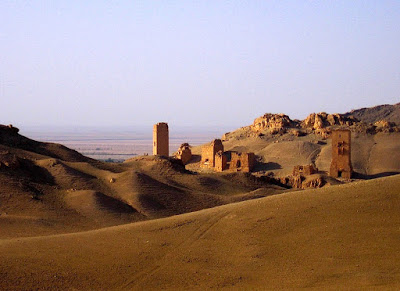
The most ancient things in Palmyra are its tower tombs; inside they are arranged in ascending rows of what look like left-luggage lockers, each filled with a body.
At evening the sun drains from the sky but the stone of Palmyra's ruined temples, arches and colonnades still seems to glow with the stored radiance of the day. It is then that your eyes are drawn to the most special thing about Palmyra, eerie and entirely alien - its tower tombs pulsing against the blackening west. Built from the first century BC, before Palmyra dressed itself in Roman forms and before its matronly and imperial pretensions, these are its most ancient funerary monuments.

Standing apart from the city, these sepulchral towers rise several storeys tall into the night. Inside they are arranged like left-luggage lockers, each body stacked atop the compartment of another. It is like having a tent with a concrete floor; their occupants have come to rest, but they still like to feel in transit.